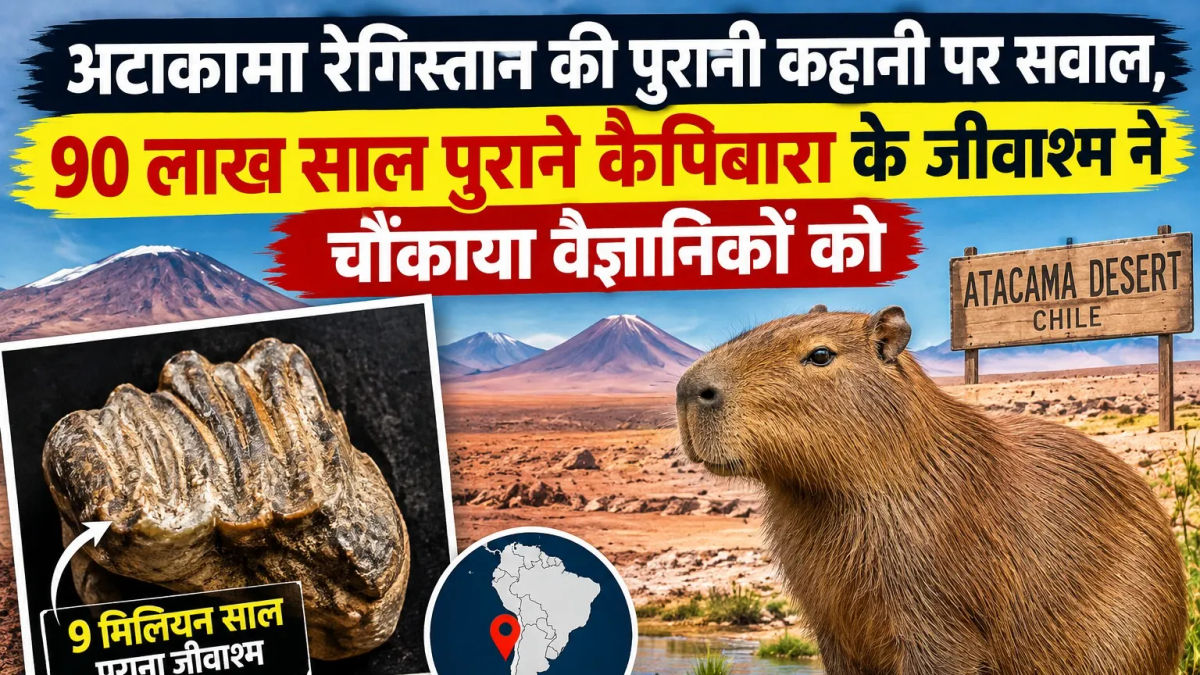
A fossil discovered in Chile's Atacama Desert in South America has raised questions about the long-held scientific understanding of one of the world's oldest and continuously arid regions. Scientists have found a capybara tooth fossil estimated to be around 9 million years old in northern Chile's Atacama Desert.
According to researchers, the discovery is significant in several ways. It is the first and oldest known evidence of the presence of capybaras in Chile's coastal region. The interesting point is that capybaras are not found in Chile today.
The capybara is native to South America and is considered the world's largest living rodent. It generally lives around rivers, lakes and other water sources because of its semi-aquatic lifestyle.
This is why the discovery of such an old capybara fossil in an extremely dry region like the Atacama has surprised scientists. The Atacama Desert is today considered one of the driest regions in the world. Several parts of the desert receive extremely little rainfall, and some locations can go years without significant precipitation.
Until now, scientists have held the view that the Atacama region has remained extremely arid continuously for around 40 million years. However, the new fossil indicates that around 9 million years ago, environmental conditions in the area may have existed that could have supported water-dependent animals such as capybaras.
Scientists believe the discovery has raised new questions about the ancient environment of the Atacama. It is possible that before the region became the extremely dry desert it is today, the area had a different ecosystem associated with water sources and vegetation.
However, the discovery of a single fossil by itself is not final evidence that completely changes the climate history of the entire desert. Researchers will now need to determine how widespread the water sources were during that period and for how long the environment remained suitable for animals such as capybaras.
The discovery has certainly presented scientists with a new puzzle about the Atacama's climate history spanning millions of years.